Showing posts with label Spanish 3. Show all posts

19 March 2012

Design your own final exam


This year as I contemplated my final exam for Spanish 3, I didn't want to do what they did last year, because I like the PhotoPeach reflection much better as a relaxing ending to AP Spanish. Since my most popular blog post ever is about student choice in homework, I thought, why not the final exam too?

My students are all interested in different things, and motivation is the primary key to language learning, so why not let them choose their own topic? They are all involved in different things, baseball and spring drama and final projects, so why not let them choose their own due date? Imposing technology on students doesn't usually work, so why not let them choose their own format? And that's sort of how the whole thing went.

Here's the info and plan they made for themselves. I hope it works as well as the homework options do!

27 September 2011

Spanish 3 assessment documents

Sometimes I feel like I'm reinventing myself every year. Do you ever look back on something you did and think, "Why on earth did I do it that way? What a bad idea! Here we go again." I feel like I do that every year! So even though I completely redesigned my Spanish 3 class last year, this past summer I attended a week-long workshop on using proficiency-based assessments, and here I am again, reinventing Spanish 3.

I give all the credit in the world to @tmsaue1 and the @JCPSWorldLang teachers who welcomed me into their learning community and inspired me to work on authentic, proficiency-based, standards-based assessments. You can view their documents here.

In the spirit of open source I also try to make everything I do available. Here are my Spanish 3 assessment documents, and the rubric I use to "grade" them (you'll notice there's no place for an actual grade). Feel free to comment here with your email if you want an editable version--they looked terrible in Google Docs as Word documents.

18 August 2011

New year, new units, new assessments

At last I've turned to working on my own classes (after looking at Spanish 1 all summer for our new teacher) and I'm (once again) re-doing my Spanish 3 units. This year I'm trying to make them more realistic. I've been heavily influenced on this by a particular #langchat last year on making assessments authentic. My assessments were fun, and used a lot of language, but didn't have a whole lot to do with what students really would do with language.

So, back to the drawing board. I've come up with the assessments for Unit 1 (titled "El esparcimiento") and just did the assessment description for interpersonal writing. What do you think?

(Of course I have to give a shout-out to @JCPSWorldLang, from whom I stole almost completely the format for this.)

27 January 2011

Instead of the vocab quiz

@SraSpanglish commented on my post "Kick the vocab quiz":
"I feel like I can't do this with Spanish I, and it's hard with Spanish II. Also, what are students graded on instead?"

At this point, I only teach very early elementary, who only receive a grade of "excellent/satisfactory/needs improvement" once a quarter, and advanced students. I realize that's quite an uncommon setup. But when I was teaching 5 periods of Spanish 1 and 2 (along with Spanish 3) I also never gave vocab quizzes. I'm a bigger fan of @alfiekohn than I am of grades, but at my school we have to give them (as, I'm sure, do you) so here's an outline of where my assessment comes from.

In Spanish 3 and 4 (AP), both classes receive grades for:
Completing the chapter guides for our books
Writing a free-topic blog post once a week
Doing listening cloze quizzes on things such as commercials
Doing a regular vocabulary review (see #1)

In Spanish 3, students also:
do intermittent writing/speaking assignments related to recent target features (in class)
do an end-of-unit assessment, profiency- and task-based, as in a how-to demonstration (to elicit commands) or telling an interesting true story about themselves (to elicit combined past tenses)

In AP, students also:
do a weekly "fluency" activity on their own
write AP-style essays & interpersonal writing pieces
do AP-style oral presentations

When I was teaching Spanish 1 & 2, students did:
-the same regular vocabulary review
-also a weekly blog post, beginning with question prompts in 1st semester of Spanish 1 and changing to free-topic word count requirements starting in the 2nd semester of Spanish 1
-also listening cloze quizzes (the difficulty is in the words you drop- for beginners, you drop numbers and greetings, for example)
-also prompted writing/speaking with target features (i.e. 5 phrases describing your family using person + es + adjective from vocabulary)

Different from advanced students, however, were:
Yes, vocab quizzes. Well, I suppose you could call them vocab quizzes because they were assessment designed to elicit vocabulary. But my format of low-level quizzes were always unannounced (to avoid short-term memory cramming) and took three forms:
1) Ask random questions to elicit vocab, and the answer just has to make sense or be true. (¿De qué color son los 'arches' de McDonalds?)
2) Ask questions about stories we've been doing in class. (¿Quién es el amigo del pingüino?) Students were required to draw/label stories in their composition notebooks and were allowed to use them for quizzes.
3) Describe a drawing for students to draw and grade on how the drawing turns out. ("Hay una niña. La niña tiene una banana verde.") Colored pencils were a supply requirement.

Hope this helps clarify how I did some of my lower-level assessment.

04 November 2009

Two songs + resources for Ojalá + subjunctive

The word Ojalá is, in my estimation, the only 'verb' in Spanish that isn't conjugated. It finds its roots in Arabic, meaning "May allah grant that." In any case, in Spanish it's always followed by subjunctive, and here are two songs to help work with that.

The first is with present, Ojalá que llueva café, by Juan Luis Guerra. It's one of those songs that can lead you in a hundred different directions. It's a bit controversial from what I understand, and is a perspective on the life of the poor in the Dominican Republic.

I found some interesting blogging on the song. For example, read what José has to say about the song and its meaning. Then, use this cool site by Ms. Nelson to work with the song, complete with lyrics linked to pictures to aid in comprehension.
I just found out that the song was re-recorded by Café Tacvba, with some killer fiddling:


The other song unfortunately does not have much in the way of resources but is the best I've heard to work with Ojalá + past subjunctive or just past subjunctive by itself (Si volvieras a mí by Josh Groban is beautiful to me but not so appealing to most of my high-schoolers). It's Ojalá pudiera borrarte by Maná. The video used to be on YouTube but was removed, and now is only available in cheesy photo collages, especially since I can't get imeem to search anything at the moment.

Ojalá que you enjoy them.

25 August 2009

I love crossover songs

I love crossover songs. That's what I call those songs that have so much good material in them that they're great from Spanish 1 to AP. Fanny Lu's new hit Tú No Eres Para Mí is one of those. It's especially good for uses and conjugations of ser. There's the title, which is of course a Spanish 1 level comment, all the way to fuera in unreal if clauses. As usual her video is too skanky for my class, but enjoy the songs. A girl making fun of a guy's cheesy pick-up lines? Super fun and lots of good grammar points. Enjoy.

29 June 2009

Developing world citizens

With all the amazing things popping up on the internet, there's no excuse not to help our students become educated world citizens by keeping them pondering important events in the Spanish-speaking world. E.g. last year's rescue of Betancourt and the other hostages was a monumental shift in the situation between FARC and Uribe and dominated an entire project in my Spanish 3 class.

So, today of course we have emerging details on the first coup in Latin America in 16 years. Such a difficult event to evaluate. Which is more important, Zelaya's democratically-elected standing, or his dismal track record/popularity with the people?

Here's a fabulous tool to keep up with what's happening, including real-time info from people on the streets of Tegucigalpa. Tweet the twub #honduras, and if you don't know what that means, just follow this link and welcome to the madness of twubs. Happy exploring!

Honduras twub: http://twubs.com/honduras

06 April 2009

A brilliant pair of songs contrasting por/para

In Spanish 3 these days we're looking at the por/para contrasts and for this I like to use two songs that nicely illustrate this unique difference.

The first is Solo por ti by Josh Groban. Yes, some students won't like it because he is a classical singer, but it's a beautiful song. Incidentally, also an excellent illustration of conditional tense, both normal and irregular. It's only available on sappy photo shows on YouTube, but you can listen to it for free at imeem.

The second song is Solo para ti by Camila. What could be better than two songs, exact same title except for the por/para switch? Perfect! Careful with the video, though--there are serious issues w/it (brief thong shot, sadomasochism, & sex scene). Play the song, skip the video. :)

09 March 2009

A new smash hit with a subjunctive benefit


Hey, my title rhymes. :-D


Luis Fonsi has a new(ish) song out that actually hit the Billboard Top 100. It's kind of slow but very catchy. The song is called No Me Doy Por Vencido, and incidentally the video is pretty good too (and 100% legal, yay!). In one part in the chorus, the verb 'buscar' triggers 3 subjunctive verbs because he doesn't know if the woman he's looking for exists or not. Enjoy it and share!

El campesino y la princesa (a Spanish 3 story test, with a bit of subjunctive)

Today I gave my 3rd quarter story test in Spanish 3. It's about a peasant and a princess who get married despite the facts that they just met and her father doesn't approve. It uses a lot of the vocab we've worked on in Spanish 3 this quarter. There's a mistake on the question part--I left a de out I think--but if there's anything else I blame it on sleep deprivation, lol.

03 February 2009

Equipping and informing, for free

It greatly bothers me how history books, history classes, and the daily news sources largely ignore Latin America. Car bombings and such in Iraq make headline news all the time because we're involved and that somehow makes them more important than such things that have become commonplace in Colombia because of a more than 40-year civil war waged by terrorists. That magnificent rescue of Betancourt and the other hostages in July--how many people even heard about that, much less could carry on a conversation about it?

My students can, especially my Spanish 3 students. They could talk to you intelligently (well, most of them, lol) about who Betancourt was, when she was kidnapped, the events leading up to the rescue and the rescue itself. They can discuss the relationships among Bush, Uribe, and Chávez.

Ah, Chávez. One of our favorite topics. My Spanish 3 students call him Mr. Danger because of this video. PBS recently did a quite good, relatively unbiased documentary on him called the Chavez Show (for Frontline). And guess what-- thank you PBS, it's available free online, in Spanish! I got a catalog yesterday for documentaries related to the Spanish world, and most of them are between $800-2000, or at least $100 per episode, sometimes as short as 15 minutes each. I don't know about you, but even if my school had that kind of money to throw around, I'd rather they spent it buying me a Smart board or more children's books in Spanish. So go watch El Show de Chávez and show it to your students. Let's do what the newspeople aren't doing and equip them to face the ENTIRE world around them.

03 October 2008

Reading in Spanish 3


I firmly believe that the best way to acquire new vocabulary is to hear it or read it, in context, in multiple contexts, many times. So, personally, I read in Spanish whenever I have the time. I rarely read fiction in English. This year I've been really in to Isabel Allende's Zorro and Inés del Alma Mía and García Marquez--specifically, Noticia de un secuestro, and now I'm reading Amor en los tiempos de cólera.


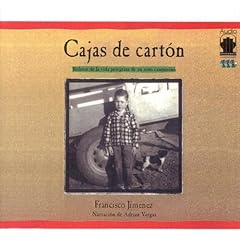
Along that line of thinking, my Spanish 3 students also read. I dislike asking them to read/view things that are decidedly American (especially WASP American) that were translated into Spanish. If we're really dedicated to all the 5 C's, we need to include stuff that's culturally rich and relevant. So, in the fall of Spanish 3 we read Cajas de cartón, Francisco Jimenez's story of how he came to the U.S. as an illegal child immigrant with his family in the 1950's. The students take a quiz over each chapter as the semester progresses, and then once a quarter I add up the grades for a test grade. In case anyone might find them useful and/or have constructive comments, I'll probably upload my quizzes for the book soon. So far I've only written them for chapters 1-5.


In case you're interested, the book we'll read in the Spring is Esperanza renace by Pam Muñoz Ryan, also an immigrant child story but from a different time and perspective (think "The Little Princess" for a Mexican aristocrat's daughter). The book I'm looking at for AP next year is Ciudad de las bestias by Allende. (I'm not sure my students will be ready for Zorro or I'd pick that one.)