For my original post about the myths, look here.
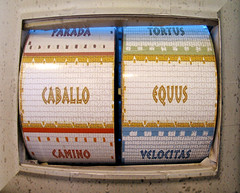
foto por Micheo
Myth #6 is this:
Students learn vocabulary in long lists of isolated words (or, we just went over bosque, why can't they remember it and remember it's masculine?).
What a mistake I used to make, and textbooks make. To think that we can give students a list of vocabulary, tell them there's a quiz on Friday, and somehow think they'll be able to use it next month, or next week for that matter.
Here's the truth: students learn words they need to do what they want to do. Think about the words you know - they are words you need to accomplish something. I don't know how to talk in Spanish about nuclear power plants. I barely know how to talk in English about nuclear power plants, and what I do know I know because my father worked at one for thirty years. Our brains are efficient - most of us just don't bother remembering terminology we never need to communicate something.
If you've interacted with me for very long, you know that my students do free-topic blogging. I once had a student who wrote nearly every week about hunting. It was his passion. The verb cazar was not in our vocabulary for Spanish 3. But you can bet that before long he knew that and the words for all the different animals he hunted. Why? Because he wanted to. In Spanish 3 every year, we read the novels Cajas de cartón and Esperanza renace. Both deal with immigrant children. Though the words are not in our vocabulary list, by the end of the year they are completely familiar with words like migra, campesino, pizcar, and frontera. Why? Because they need them to talk about the issues in the books.
It's one of the most freeing things that has ever happened to me in my professional life to come to the realization that students will naturally acquire the vocabulary that interests and helps them without me drilling or quizzing it.
As a few resources for you, check out the archive of last year's #Langchat on rethinking how we teach vocabulary. I also have done several blog posts on this topic, including how I do vocabulary (surprise! I do give out vocab lists!), why you should kick the vocab quiz, and what you might do instead of the vocab quiz. Also check out cybraryman's page on teaching vocabulary, as well as Edutopia's insightful post on the topic.
If you're into research, read up on what it has to tell us about teaching vocabulary, including that shallow processing memorization doesn't work. For a tempering opinion, if it's worth a book purchase to you, you could read Vocabulary Myths by Keith Folse, who warns that throwing out vocab lists and stopping teaching it explicitly is too dramatic and not actually an answer to the vocab question.
However you decide to present and teach and review your vocabulary, my advice is to seek more ways to focus on these five keys:
1) motivation - make it vocabulary students find interesting.
2) useful - students see value in vocabulary when they can see themselves using it.
3) frequency - in every way you can think of, integrate the vocabulary that everyone uses.
4) phrasal - fool with words and phrases to encourage chunking of words commonly used together
5) less is more - concede that students can only acquire so much at a time, and give up on the rest (at least until later).