Showing posts with label games. Show all posts

17 June 2011

Activity #5: Gira la botella


Fun activity #4 is 'Gira la botella,' or 'spin the bottle.'

I forget what the original purpose of this game was (in language class, I mean, haha), but I tweaked it to be a game to practice idioms. I find that one of the hardest parts of vocabulary acquisition is getting students to really use idioms in their speech and writing. Part of the problem is a lack of practice in seeing and using them repetitively in a meaningful context. Imagine my dismay when I found out one of my fourth-year students who had practically memorized Luis Fonsi's song No me doy por vencido still had no idea what the expression meant. Doh! (on me, not her) I guess songs don't cure all ills. (Did I just write that?)

Anyway, back to the game...
  • In a document, make a list of common idiomatic expressions for your language, expressions you want your students to be able to use in appropriate contexts spontaneously.
  • When this game is chosen as a class activity, copy and paste your list into the random chooser. Run the chooser so it selects an expression. (Be sure to use the fruit machine, not typewriter, so you can remove the option after it's used.)
  • Get your students into a circle. It's always good to have an opportunity to change things up, and get them up and moving, eh?
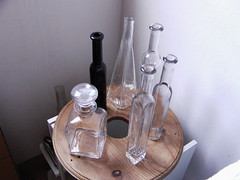
  • Spin a bottle in the middle of a circle. You can use any bottle but for cultural effect we use a Manzanita bottle (my favorite Mexican beverage).
  • When the bottle stops, the person at whom it's pointing begins a sentence with the idiom. For example, "No me doy por vencido en la clase de matemáticas."
  • Going clockwise, the next person has to remember exactly the sentence and add a detail: "No me doy por vencido en la clase de matemáticas por la mañana."
  • The first person to forget any of the sentence is out and has to sit down. Spin the bottle again, choose a different idiom, and keep going until you're done (or we time our game for 10 minutes).
I imagine you could use this for any vocabulary you're targeting and it would work the same way. I particularly like idiomatic expressions because it's such a real way to push real communicative proficiency at every level.

Have fun, and no kissing! ;-)

26 April 2011

Activity #4: Drama Inmóvil

Fun activity #4 is "Drama Inmóvil," idea courtesy of Paulino Brener.


My students LOVE this. They beg for it- even the ones who will never talk in class. You must try it, and if you're anywhere around a unit building on present progressive, you should do this every day for the first five minutes at least.

I copy/paste my class roster into the fruit machine picker and it chooses a random student. That student stays seated and all the others come to the front (you may have to do this in groups - my largest class is 8 so we can do it as whole-class). The chosen student gives a place and/or situation, e.g. in a park, or at an amusement park, or at the movies. I say 'lights, camera, action' (in Spanish) and all the 'players' adopt a frozen pose of what they are doing in the situation. Then I go around with a pretend microphone and interview them with rapid question/answer style - "Where are you? Why? With whom? Who's winning?" etc. Then the chosen student selects who was the most creative (they just get cheers for it; there's no prize, but they don't care), I remove the chosen student's name from the fruit picker and do it again.

It's a winner. My dramatic students get crazy with it. My shy students do something expected but are eager to talk about what they're doing, especially because the q&a style doesn't involve me standing at the front of the class saying, "Now, remember to answer with a complete sentence" (who says that in real life anyway?).

I made a video of my students doing this and posted it as a private video on YouTube for Paulino. I don't have permission to show my students on my blog or on YouTube publicly, but if you are a teacher and you'd like to see how it worked for us, send me your email and I'll add you as a viewer.

13 April 2011

Fun activity #3: ¡Arriésgate!

Fun activity #3 is Jeopardy (¡Arriésgate!) courtesy of the great web 2.0 tool Jeopardy Labs (free and no account required!).

photo by Justin Levy

I've known about this tool for a long time but never just sat down and used it. It's easy to make and easy to use (except there's not really a function for no one to get the answer right--it keeps the question on the board until you give someone points for it).
I recommend that you stay away from categories like "conjugations" and "fill in the definite article." You can easily make it fun and more communicative by looking at your vocabulary and asking yourself, "What actual questions can I ask with these?" So you could have 'ropa' (clothing) 'comida' (food) 'opuestos' (opposites) 'en la casa' (at home) and then make all your "answers" target-language clues. So for 'closet' put 'where you put your clothes in your room' - avoid students getting confused by making all the "questions" start with the same letter.
Try mine (in Spanish, of course). My students are advanced so you can see some of it would be way over level 1.
And remember - answer in the form of a question. :)

02 April 2011

Fun activity #2: A conversar

I blogged a few days ago about coming back from CSC11 with some good ideas to make my class more fun (along with some suggestions via Diego Ojeda of #langchat "fame" ;-) and putting them together into a 10-minute class starter.

photo by Rohit Rath


The second one is "a conversar." For this one, students pull a conversation card (that I made) out of a card box and talk to anyone about question on the card. When they're done, they go back and choose another. The first time my AP class did it, I sat back amazed. I cannot get this class to speak in the TL for the life of me, and there was *loud* Spanish chatter for a solid ten minutes. Adjust questions for your level, and make them interesting - e.g. "¿cuál es mejor, un abrigo azul o un abrigo café, y por qué? instead of ¿qué es tu color favorito?

Here are some of the conversation starters I found on the internet and wrote on my own:
  • What's the craziest thing you've done?
  • What is the most serious mistake of your life?
  • Describe the happiest day of your life.
  • What's your best friend like?
  • Describe your favorite movie.
  • What is your favorite free-time activity? With whom? Why?
  • Who are your heroes? Why?
  • What did you do yesterday? With whom?
  • What books have you read recently? Describe them.
  • What do you want to be and do five years from now?
  • What has been an important experience in your life and why?
  • Describe your favorite restaurant.
  • What is your opinion about the problems in Libya?
  • What are your plans for tomorrow?
  • Describe an interesting trip you took.
  • If you could have any job in the world, what would it be?
  • Why did you choose to take advanced Spanish?
  • What is your first memory?
  • What do you want to do during vacation (Spring Break, summer, Christmas, etc.)?
  • Do you like your neighborhood? Why or why not?
  • What would be the title of your biography? Why?
Enjoy and let me know if you have more good questions I can add.

10 February 2011

For tonight's #langchat: A game for description

Tonight's #Langchat topic is using games to support instruction. I have no idea how to describe a game in 140 characters so I thought I'd post it here.

This is a game good for low levels. It works great to reinforce describing people. It's useful for students to have the verbs 'have' 'wear' and 'is.' The game is called "¿Quién tiene la moneda?" (In Spanish, "who has the coin?")

One student leaves the room and the teacher gives a coin to someone in the room. All students should know who has the coin. The excluded student comes in and can ask anyone a yes or no question. Everyone except the student who actually has the coin must tell the truth. The student who has the coin can lie--this throws a twist of strategy into it.

So the student who is asking should ask questions like
--is it a boy?
--is he wearing blue?
--does he have blue eyes?
--is he blond?
--is he wearing glasses?
You can make things interesting like limiting the number of questions, and then forcing a guess. If the student guesses correctly, he chooses someone to go out next. If not, the student with the coin goes out next.

You can also substitute items for the coin -- pencil and other early vocab, for example.

Have fun!

31 August 2010

Interactive comic creator using Maya & Miguel


The Pbs Kids website's Maya & Miguel section not only has a nice selection of Spanish fun, but one of the features is an interactive comic creator, in which you select the background and then choose which words you want to use and which pictures match the words.  Wait-- it's in Spanish, you choose the words, and then you choose the pictures that match the words? Does that sound like some seriously fun vocab acquisition and practice or what?  I don't care if your students are nine years old or in ninth grade, you've got to try this out.

17 February 2009

Interactive websites: practicing house/location/color vocab

If you have a way to project a webpage somewhere in your room, you've got to check out es.barbie.com. We did this in Spanish 1 today to practice house vocabulary, but you could use it for so many things. We also did the makeover part of it to practice colors. It's amazing how much they can pick up off a website just from context because they spend so much time online! Also, I have to tell you that my freshman boys were almost more involved in this than the girls. For whatever reason--because it was girls or whatever--they were calling out how her hair should be, what color eye shadow, etc. It was a lot of fun.

Remember, if we frustrate them, they'll give up, and that's the blunt truth of it.

13 February 2009

Subjunctive for doubt: Story, song, activity

One of my problems with standard curriculum is they can't provide enough variety in activities focused on one issue. They try, I'll give the writers credit for that, but there are only so many textbook/workbook exercises you can design to elicit subjunctive for doubt. And really, do we believe that those cheesy textbook videos offer enough patterned input for them to understand anything except how bad the acting is?

So I don't use a textbook. My lesson activities include stories, drawings, writing, songs, and, occasionally, a game. This is what we've been doing for subjunctive by reason of a verb following an expression of doubt.

STORY:
Two students in the class were talking. A boy and a girl. Who are they? (the students decide) They aren't big though. They're small. They're not in high school. They're in preschool. It was a long time ago.
What were they talking about? Their hermanos? No. Their mamás? No. They were talking about their papás.
The boy said, "MY papá goes to China every month."
The girl said, "I doubt that your papá goes to China every month. MY papá has 15 birds in his bedroom."
And we continued with different phrases. I organized it by putting two speech bubbles beside each character on the board. The top speech bubbles were for what they said about their papás. The bottom speech bubbles were what they said to doubt the other person's statement. We used places around our area and vocab we've worked on lately, but you can make up anything. As long as it's interesting and relevant, they'll stay focused. And mine picked up the pattern by the 4th or 5th doubt statement and were able to change the verbs themselves. Our statements were:
MY papá...
...lives in Bernheim Forest
...knows President Obama
...gives me chocolates for breakfast
...dies when he eats shellfish
...can walk 15 miles
...can drive his Corvette 100mph

(At the end we added that they both said "I want your dad to come to Show n Tell" to rehash a subjunctive for influence example.)

The next day, our song was No Sé Si Pueda by Fonseca. You can listen to the song on YouTube but there's no video for it. It's a good example of subjunctive for doubt.

The day after that, we played "two truths and a lie." I divided the class in half, and each person wrote 3 statements, 2 true and 1 false, in no particular order. (I collected these afterward for a 10-point completion/effort grade.) The team got a point if the other team could not guess which one was the lie. Then, we put "dudamos que..." in front of the one the majority had thought was the lie, and they told me what else in the sentence had to change and why.