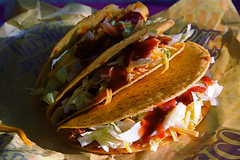
photo by Steven de Polo
So, about informing our students on proficiency.
One of the great ideas that came from that PD I went to was this 'taco' activity. It's designed to be done in the first days of school, preferable on the first day unless your first day is taken up with 'administrivia.'
Divide students into four groups, or tell them to divide themselves into four groups.
Tell students that you want them to tell you what a taco is, in English. You can choose any other common object or activity, such as the circus. For the first group, tell them that they can only use individual words to talk about the taco. In the second group, they can use phrases. In the third group, they can use simple sentences. In the fourth, they can use descriptive language in compound sentences joined by transition words like 'next' and 'also.'
When students use their 'proficiency level' to describe the taco, assign the proficiency labels to what they have done. Talk about which description gives the best idea of what the object/activity really is and why that level should be a goal. We also discussed having students write on large chart paper their descriptions, so that you can put them up on the wall. Then you can post on the chart 'novice low' and 'approaches expectations' and 'C' or whatever your assessment feedback language will be, and the students can have a visual reminder all semester or year of what exactly your expectations are.
Several teachers mentioned that this activity gives students a real idea of how accessible language is and gives everyone in the room a realistic view of where they could be at the end of the level. For the group of teachers I was with, their expectation is Novice High at the end of level 1 and Intermediate Low at the end of level 2 (they haven't done level 3 yet).
I thought this was a great way for students to be introduced to proficiency levels and get away from the vague 'here's a list of units we may or may not finish this year'-type goals I've done before. What do you think?


