
Showing posts with label resources. Show all posts
Showing posts with label resources. Show all posts
06 January 2012
Free Ebook for WL educators


08 June 2011
Myth #5: The textbook is all I need
For my original post about the myths, look here.

photo by NomadicLass
Textbook companies make a lot of money off of telling us that they've done all the work and they're all we need. Audio? They've got it. Video? That too. Activities? Structure? Assessments? It's an all-in-one package, for a price. And out-of-date as soon as it's printed.
It's no secret I'm not a fan of most textbooks. There must be some magic textbook out there that I haven't seen that is so communicative and fabulous, but the ones I've used before leave me wondering, who wrote this? I know they say they're aligned with standards, but what are my students actually supposed to be able to do after this activity? The activities are stale and forced, the vocabulary is endless, and the assessments are designed for easy grading instead of actually assessing language ability.
There's something to be said for having a structure. I don't think I've met a teacher who has just jumped into textbook-free teaching. For me, it was about a two-year process, and it wasn't even on purpose. At some point I just realized that we weren't taking the textbook off the shelf anymore. I realized that using online resources and storytelling and my own activities turned out to be so much more freeing, motivating, authentic, and up-to-date (after all, language is constantly changing). Not to mention it costs less.
Tying ourselves to a textbook and its cheesy, fake, tedious accessories because 'it's all we need' is a myth that is preventing our students from acquiring the real language it takes to communicate with real people. Even if you use a textbook you love, look beyond it to the world of resources that will enrich and inspire your students more than your textbook ever will. Take a look at what the Twitter PLN is talking about. Explore the resources others have shared with me. Look at some of my blog tags like internet activities, YouTube, and assessment. And soon, I'll be posting my summer project: units with activities, standards-based "I Can" statements, and assessment ideas for Spanish 1 - AP Spanish. Steal, thieve, borrow. Collaboration makes the PLN go 'round.
04 February 2011
Ciudad de las bestias: Guides public & streamlined
 I wrote here about what I've done with the book Ciudad de las bestias by Isabel Allende in my AP class. I recently put all of the chapter guides with their "palabras claves" in one streamlined Google doc, public on the web. It should be easier to use and as always happens with time, more accurate as my students find mistakes (like incorrect page numbers) and I fix them. If you have any suggestions or comments, as always those are welcome.
A few notes about the guides/words:
- The guides get longer because 1) the students become more capable and less in shock and 2) the chapters get more complicated in regards to the plot
- I use a "did you read" question at the end of every guide, worth at least 10 points, more according to the length of the chapter
- sometimes there's a ¿? instead of a definition of a "palabra nueva" because while the phrase itself is new, it's related to words the students know, and so I think they should be able to figure it out (e.g. desangrar).
- at this level my students read mostly on their own but we try to make time for it in class, and the day it's due they come in with questions and we read through tough sections together - this lessens their frustration
Have you thought about writing guides to literature for your own class-- and sharing them for other teachers? Collaboration is the 21st-century skill. :)
27 December 2010
I love collaboration
Ever since someone said something about not reinventing the wheel it seems we've all been in a search to see how much of our work other people have already done. Right?
Not really. Actually we still have a tendency to shut ourselves in our classrooms and overwork ourselves and burn out doing things that hundreds or thousands of other teachers have actually done and some have shared if we just knew where to look.
I'd love for my blog to be an opportunity for me to share places to look. I just joined this wiki, Language Teachers Collaborate, and today I added a page called Authentic Audio. Click. Explore. Request access. Collaborate. It's what makes the teaching world go 'round.
01 October 2010
In the spirit of open source: Ciudad de las bestias
Want to guide your advanced students through a culturally-relevant novel by a Hispanic author, written specifically to adolescents? Good! Intensive reading for pleasure is the best way to acquire vocabulary in any language.

I've put an incredible amount of work into writing reading guides and vocabulary lists for all 20 chapters of Ciudad de las bestias by Isabel Allende.
In the story, Alex, a 15-year-old Californian, must spend some time with his eccentric grandmother while his mother receives cancer treatment in Texas. His grandmother is a nonfiction adventure writer, about to leave with a team from "International Geographic" for the Amazon, in search of the (mythical?) Bestia--the 'abominable jungleman.' Alex's presence can't throw a wrench in her plans so he must tag along. Suddenly the California boy finds himself in the middle of the Amazon, picking off leeches, swimming with dolphins, befriending a young Brasilian-Canadian girl with whom he gets kidnapped and must embark on a journey to answer tough questions about who gets to use what in the jungle and what the future holds for the indigenous peoples of the Amazon, as well as where his true riches are and where he can find purpose.
Sound like culture? communication? motivating subject matter for teenagers?
My reading guides aren't perfect--just the other day one of my students pointed out I hadn't put page numbers on a few questions-- but here they are, and I encourage you to see the power of reading come alive for your advanced students.
**UPDATE 3 FEB 2011** For new info on these guides, see this post.
I'll try to post some tips on class novel reading soon, but my first one would be to start reading together before assigning it outside of class, so students can get used to the big keys which are:
1-read the question first so you know the big idea you're looking for
2-read so you understand the gist, but not so you understand every word.
23 September 2010
Books recommended as 'easy'
I found a helpful post on Amazon.com where someone recommends easy novels to read while learning Spanish. I hope to order them and see whether they might be good for Spanish 2, since I'm all about feeding kids authentic rather than learner Spanish from the beginning.
One is La Tierra del Fuego, and the other is El Clan de la Loba/La Guerra de las Brujas.
For Bethanie, who asked a long time ago, and anyone else who cares.
**update**
Here are a couple of other options recommended to me via Twitter and Amazon:
A children's sensation in Spain, Manolito Gafotas (if you can find enough copies en español)
The last of the Manolito series, Manolito Tiene un Secreto
Adventure novel Limpieza de sangre
El pirata Garrapata (and sequels)
31 August 2010
Interactive comic creator using Maya & Miguel
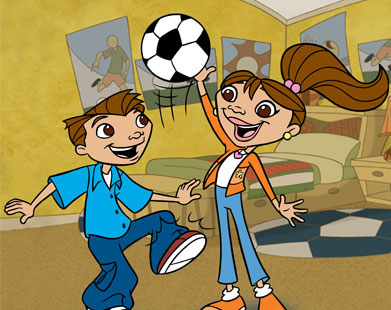
The Pbs Kids website's Maya & Miguel section not only has a nice selection of Spanish fun, but one of the features is an interactive comic creator, in which you select the background and then choose which words you want to use and which pictures match the words. Wait-- it's in Spanish, you choose the words, and then you choose the pictures that match the words? Does that sound like some seriously fun vocab acquisition and practice or what? I don't care if your students are nine years old or in ninth grade, you've got to try this out.
15 August 2010
Added some great new links
I've tweaked some of my links on the right - added a couple of "communicative bloggers" and some "communicative tools" including a FANTASTIC YouTube channel for anyone who's raising bilingual kids or teaches Spanish to children. I also finally replaced the old Yahoo radio link with a new link to my Pandora station, so you can listen to the station I use to find almost all the pop music I use in my classroom.
There's so much great stuff out there. :)
There's so much great stuff out there. :)
11 October 2009
We must not ignore the Paz Sin Fronteras (video)
Juanes's Paz Sin Fronteras concert was such a big deal on the world politics scene (he's more deserving of the Nobel PP than Obama, but don't get me started on that, lol) that it would be a shame for a Spanish teacher to pass up the opportunity to encourage world citizens in our classrooms. Here's a videoclip I found on YouTube that's one of the best. It's short, interesting, summative, with incredibly clear audio and IMO the woman's Spanish is uber-comprehensible through most of the video. It almost sounds like she thinks she's talking to language learners!
20 September 2009
For you French teachers
This weekend I was at the fall conference of the Kentucky World Language Association (phenomenal!) and after I gave my presentation on YouTube and pop music, it occurred to me I should have offered the French teachers present the url of my favorite French-teaching cyberamiga Diane (@parisprimrose), Foreign Language Fun.
Subscribe to:
Posts (Atom)


